
The Swiss Franc: The Ultimate Reserve Currency
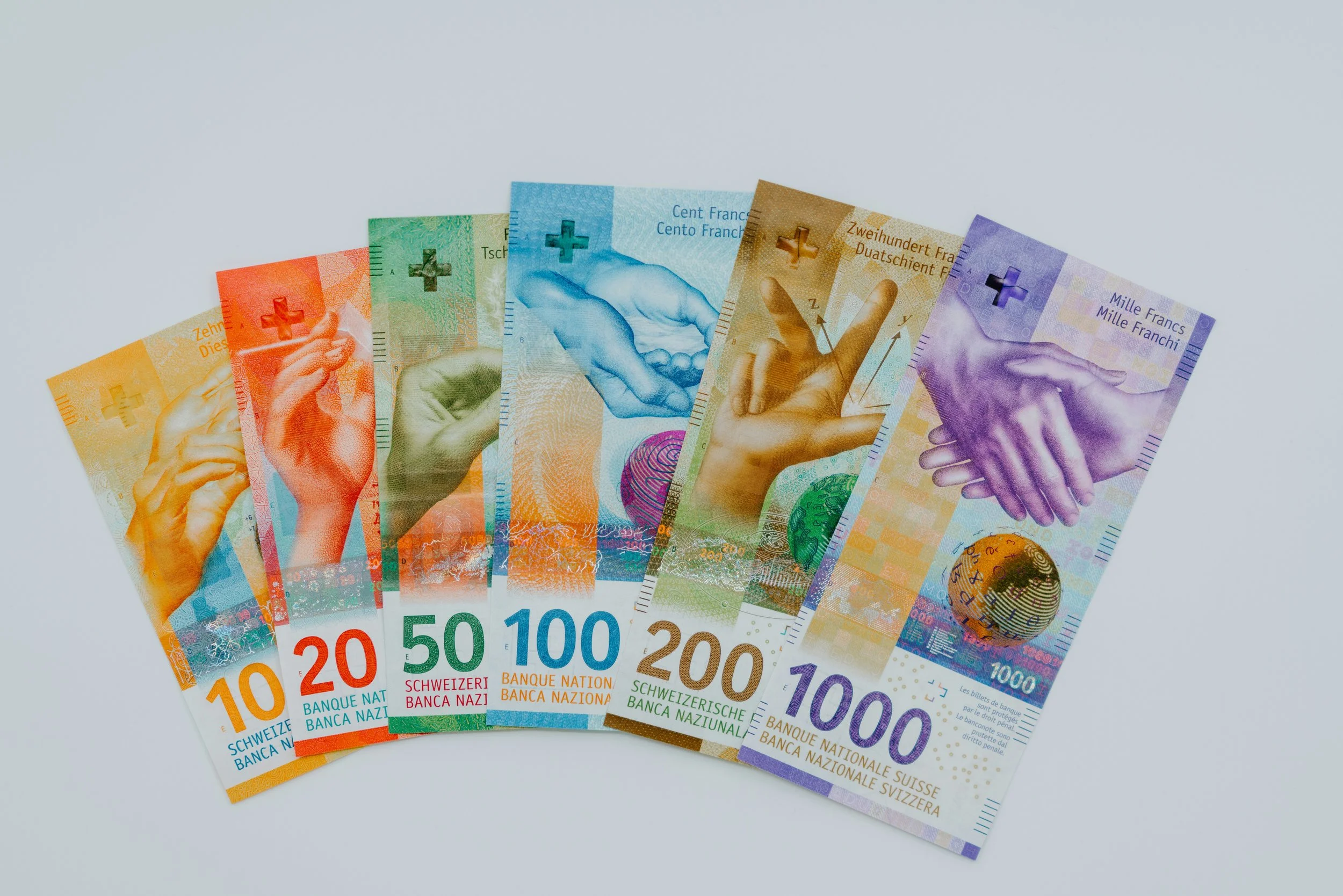
Published April 29 2026
In a world where inflation erodes purchasing power, geopolitical tensions destabilise economies, and central banks print money at will, one currency has consistently stood apart. The Swiss franc has earned a reputation as the world's most reliable store of value. It’s a safe haven that investors, institutions, and governments turn to in times of crisis.
A Fortress of Political Neutrality
Switzerland's most powerful monetary asset is not printed on paper, it is written into the country's political DNA. For over 500 years, Switzerland has maintained a policy of armed neutrality, refusing to take sides in foreign conflicts, alliances, or political blocs. It is not a member of the European Union or NATO, and it only joined the United Nations as recently as 2002.
This neutrality has a direct and profound effect on the franc. When wars break out, sanctions are imposed, and geopolitical alliances fracture, as is the case in today’s global economy, investors instinctively flock to currencies insulated from political fallout. In moments of global crises, from the Cold War to the 2008 financial collapse to Russia's invasion of Ukraine, the franc has surged as capital fled uncertainty.
For a reserve currency, this is invaluable. A nation that takes no political sides offers a neutral monetary home for capital from all corners of the world.
An Unrivalled Record of Monetary Discipline
The Swiss National Bank (SNB) has long been one of the most conservative and credible central banks on the planet. While others have engaged in decades of quantitative easing and politically motivated rate manipulation, the SNB has maintained a reputation for placing long-term monetary stability above short-term stimulus.
Switzerland's inflation record speaks for itself. Over the past century, the franc has experienced fewer and shallower inflationary episodes than virtually any other major currency. In 2022, when much of the developed world grappled with inflation rates of 8–10%, Swiss inflation peaked at around 3.5%, remarkable restraint by any measure.
This discipline is not accidental. The SNB operates under a constitutional mandate to ensure price stability and Swiss political culture is deeply sceptical of inflationary policy. The result is a currency that preserves purchasing power over time, the fundamental requirement of a true reserve asset.
An Exceptionally Sound Banking System
Switzerland is home to one of the most sophisticated and well capitalised banking systems in the world. Swiss banks are subject to some of the strictest regulatory requirements globally, holding higher capital buffers and liquidity ratios than their peers in the US, UK, or eurozone.
Beyond regulation, Switzerland's banking system benefits from centuries of accumulated expertise in wealth management. The country manages roughly a third of all globally held offshore private wealth, an astonishing concentration that reflects deep international trust in Swiss financial institutions.
This financial depth creates a virtuous cycle for the franc. As more global capital pools in Swiss banks, demand for franc-denominated assets rises, supporting the currency's value. As the franc remains strong, more capital flows in.
A Deeply Competitive and Resilient Economy
It might seem paradoxical that a tiny, landlocked nation with no natural resources and a population of just nine million can sustain one of the world's strongest currencies. Yet Switzerland consistently ranks among the most competitive economies on earth, topping the World Economic Forum's Global Competitiveness Index year after year.
The secret lies in relentless specialisation: precision pharmaceuticals, luxury watchmaking, speciality chemicals, medical devices, and financial services. Companies like Nestlé, Novartis, Roche, and ABB are global titans whose exports command premium prices that cannot easily be replicated elsewhere.
This economic strength produces persistent current account surpluses. Switzerland consistently earns more from the rest of the world than it spends. Countries with significant surpluses are net exporters of capital, and their currencies tend to appreciate over time.
The Ultimate Safe Haven in Times of Crisis
Perhaps the most decisive argument for the franc as the ultimate reserve currency is its proven track record as the world's premier crisis hedge. When fear grips financial markets, the franc does not only hold its value, it actively appreciates (see below graph).
During the 2008 global financial crisis the franc surged. During the eurozone debt crisis of 2010–2012 it surged so dramatically that the SNB imposed a temporary currency ceiling to prevent damage to Swiss exporters. During COVID-19 it again acted as a magnet for fearful capital. And in 2022, as war returned to Europe and global inflation spiked, the franc once more outperformed virtually every other major currency.
This behaviour is structural. The franc's safe-haven status is self-reinforcing. When investors expect it to rise in a crisis, they buy it during a crisis, which causes it to rise, which validates the expectation. No other currency has replicated this consistency across so many different types of crises over so many decades.
The Swiss franc is more than a currency. It is an institution. Backed by centuries of political neutrality, monetary conservatism, financial sophistication, economic excellence, and crisis tested credibility, the franc offers what no other currency can match: genuine, durable safety. In an era of rising global uncertainty, the case for the Swiss franc as the ultimate reserve currency has never been stronger.
Disclaimer
This report has been prepared by Nabla Delta for informational purposes only and is not intended as an offer or solicitation for the purchase or sale of any financial instrument. The opinions, estimates, and projections contained herein are those of the firm as of the date of publication and are subject to change without notice. Nabla Delta may from time to time have positions in or options on the securities mentioned in this report and may trade for their own account.
This research is based on information obtained from sources believed to be reliable, but we do not guarantee its accuracy or completeness. Neither Nabla Delta nor any of its affiliates accept any liability whatsoever for any direct or consequential loss arising from the use of this document or its contents.
Investors should consider this report as only a single factor in making their investment decision. This report does not take into account the investment objectives, financial situation, or particular needs of any specific investor. Investors should obtain independent financial advice before making any investment decision.